Ripples of Hope: Robert F. Kennedy at 100


It has been 58 years since he died, and it is still hard to take the measure of Robert F. Kennedy, or RFK for short. He was mostly a brother in his lifetime: a campaign manager, an Attorney General and then the younger brother to whom the torch of leadership and obligation was passed. Again, as a brother, he had to battle past his own dark night of the soul to take up a substantial burden, knowing that every time he rose to speak in front of a crowd it was to stare his own death in the eye. But the Kennedy magic, both a blessing and a curse, attached to him, and he quickly became a Senator, then a rebel candidate for President. Almost as quickly, he too was killed at the age of 42.
What echoes today in a world seemingly bereft of inspirational political leadership is an almost mythical memory. Like all leaders who die young, Bobby is frozen in death as larger than life, vulnerable to either derision or hagiography. As a memory, he evokes an era of political passion and social commitment that stands in haunting contrast to 1988. As a myth, he is a vessel into which all dreams can be poured, a kind of Rorschach test for people to project their own values onto.
Almost six decades ago, Kennedy had just won the Nebraska primary. Roy Lichtenstein’s celebrated pop portrait on the cover of TIME captured all the vibrancy and passion of Kennedy’s surging campaign. Three weeks later RFK lay on the floor of the kitchen of the Ambassador Hotel in Los Angeles. The anniversary of that heady quest and its horrifying finale has become an occasion for a subdued outpouring of nostalgia, bespeaking a sense that something is missing in the Trumpian era.
The continued persistent nostalgia about Kennedy seems to embody an inchoate yearning for a time in U.S. political life when everything seemed possible: topple a President, end a war, bring peace between the races, fight poverty and injustice. Whatever verdict history renders on the short life of RFK, one thing is certain: he brought a passion to public life, a sense that government in the hands of the right people could be mobilized for something good. Politics mattered. Like other times when the country gave up its individual dreams for a collective vision — during the World Wars, the Depression, the Moon landing — there seemed to be a brief moment in the ’60s when people believed that one person, by force of character, could seek a newer world. There is a palpable sense of nostalgia for this country as it used to be and can never be again.
Both friends and foes have enlarged Kennedy beyond what he was in life to the point where it is hard to separate the myth from the man. With his remarkable charisma and ability to connect with those of any race or creed, social strata or political philosophy it is tempting to see him as a kind of secular saintly figure whose ability to cross But Bobby was, of course, much more complicated than the myth will allow, more flawed and human.
The myth has no time for the bad Bobby, the mean Bobby, in its memory. It glosses over the aggressive young Kennedy who, as counsel to Joseph McCarthy, relished hunting down Communists; the zeal with which he pursued Jimmy Hoffa; the ruthless campaign manager who cut down political bosses who did not toe the party line; the Attorney General who acquiesced in J. Edgar Hoover’s request to tap the phone of Martin Luther King.
But without the bad and the ugly, the picture is distorted and his subsequent political odyssey incomplete. If he had not been a pragmatic hardball player, he would never have entered the presidential primary after Eugene McCarthy had cleared the way. Without his calculative, hard-nosed side, RFK might not have been able to put together the remarkable coalition he eventually did. Conservative working-class whites may have been willing to help the needy, but fearful of being taken advantage of, they wanted a tough guy in charge. The impetuous young Bobby helped make the grownup Bobby more compassionate.
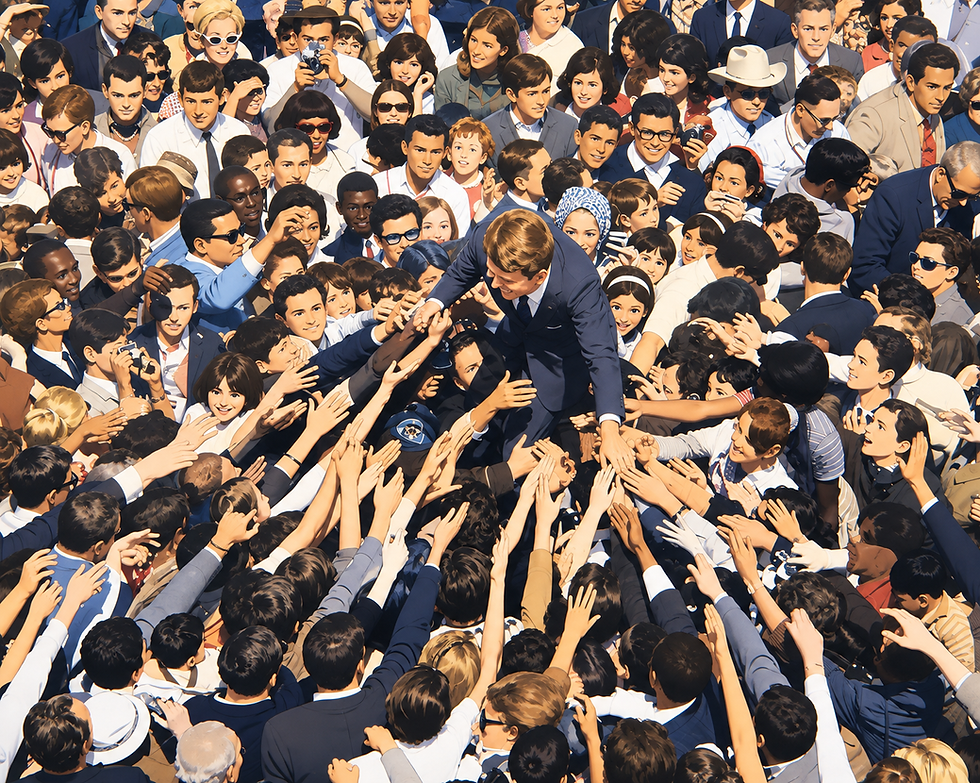
As a Senator and candidate, Bobby revived and embodied for millions the hopes that died with his brother at Dealey Plaza. Even among skeptics, there was a sense that Kennedy grew into his own after his brother died. History — two assassinations, a war, a racial struggle — changed him and given time he might have changed history.
The shooting of Martin Luther King, a mere19 days after Bobby plunged into the 1968 campaign, accelerated his transformation. The war, Kennedy’s ostensible reason for getting into the race, gave way to a clarion call for an end to racial hatred and intractable poverty. In speeches scribbled on note pads in the days after King’s death, Kennedy made some of his most eloquent appeals. “For there is another kind of violence, slower but just as deadly,” he declared. “The violence that afflicts the poor, that poisons relations between men because their skin has different colors.”
The compassion he preached was not part of a cold political calculus designed to forge a winning electoral coalition. Though much of what RFK did was carefully planned, his pleas for racial harmony and social justice — delivered to conservative whites in Terre Haute, Ind., as well as to blacks in Gary — seemed to reflect deep and true personal convictions. He was a latecomer to civil rights when he saw it as a threat to his brother’s political standing, but he was passionate in the cause of social justice after being exposed to the sight of young blacks falling outside a system that seemed to hold no promise for them. The son of privilege, he was at first appalled then offended by the conditions of the poor which robbed them of dignity and hope. He was vexed by the simple dichotomy inherent in the social and economic order besetting the worlds’ most affluent country.
Kennedy was credible to blacks and whites because he delivered messages to each group that they did not want to hear. He told blacks there would be no guaranteed income. He told poor whites in Kentucky to get up off their porches and clean up the abandoned cars pocking the landscape. He told everyone to “work their butts off.” He didn’t pander to labor by promising to work for the repeal of the Taft-Hartley Act, which curbs strikes. He told students he would end the shame of college deferments. He preached, as only few contemporary leaders has been able to since, that fathers must take care of the babies they made. He spoke of the crippling effect of welfare. And when an audience of medical students asked who was going to pay for the help that he said must be provided to the poor, Kennedy had a simple answer: “You are.”
Robert Kennedy may have been the last major white politician black people seriously heeded. He seemed to be a friend of life’s victims, as rich men can afford to be but seldom are. He came naturally to the outsider’s mentality. As the physically smallest and scrawniest of the four Kennedy boys, he was lost amid the physical grace and athletic prowess of his brothers. Where Joe and John were debonair and cool, Bobby was intense and awkward, the little guy trying to catch up. Shy, with few friends, he did poorly in school and sports. His father hardly noticed him. He could easily have rebelled, become the embarrassing younger brother that besets many prominent families. Instead, he simply tried harder to win his father’s approval. He became the scrappy family errand boy, which earned him his ruthless reputation but gave authenticity to his empathy with those left out.
There was not much time to put what he said into action. But his success in launching a community rehabilitation program in the Bedford-Stuyvesant part of Brooklyn showed that the poor, with the self-interested help of corporations and unions and banks, could bring a devastated slum back to life.
What causes particular wistfulness among observers and historians is that Kennedy had more potential than most politicians, perhaps even more so than his brothers. Unlike others, he had his dual citizenship going for him: a tough pragmatist among working-class whites and a man of compassion among blacks, Hispanics and the poor. David Farber, author of Chicago ’68, says Kennedy could have allowed the blue-collar people “to come through the ’60s without falling prey to the fears that took over so many people.” He was a politician who could talk about law-and-order without sounding racist and about gun control without sounding soft on crime, who could advocate government help without sounding radical and self-help without sounding reactionary.
Even with his California victory, minutes before he was shot, Kennedy would have had trouble wrestling the nomination from Vice President Hubert Humphrey, who was by then only a few dozen delegates away from a majority. But optimists speculate that RFK would triumph in Chicago, then gone on to defeat Richard Nixon. That would probably have meant an earlier end to the Viet Nam War, an extension of civil rights reforms, no Watergate scandal, and a whole different perception of government and politics than the one that pervaded the 1970s. No one, of course, can say with certainty what would have happened had Bobby lived. But there are intriguing indications. It is not implausible that he would have retained Humphrey’s basic vote, cut into George Wallace’s southern base, and turned out large numbers of disaffected voters that Humphrey never could rouse. That might have been enough to overcome Nixon, who would have suffered the ignominy of being defeated by two Kennedys in a row.
But time is a fickle thing, and the Kennedy mystique has faded over the years as the political dynasty’s grip on power loosened with newer generations. RFK Jr, currently Donald Trump’s Secretary of Health, seems poised to erode this memory further as he charts a far more libertarian course than his father or uncles.
Yet, if interest and recollection in the family recedes, Robert Kennedy’s memory has proven more resilient, his brand of pragmatic progressivism still echoes though in today’s contemporary landscape there seems to be no candidate who can replicate his crossbench appeal. His constituency was unique, a collation really, and perhaps one only suited to the particular distemper of his times.
Bobby was able to spark excitement by articulating dreams. Given today’s dearth of passionate, visionary leaders, it is no wonder that the young people who embraced politics in the ’60s — and whose faith in government was undermined by Viet Nam, assassinations and Watergate — should remember Kennedy as a hero. And that the younger generations of today should be prompted to find their own role models or personal inspirations.
Whenever pollsters ask voters for their heroes, the rich and famous and superficial head the list: celebrities standing in for real heroes. But the current global wave of antiestablishment fervor may be a signal that the generations that retreated to self-absorption may be ready to feel passion again, so angry are they at the perceived failures of the political class. That figures like RFK continues to be a hero to them could be more than nostalgia; it may suggest a yearning, once again, to re-engage, and to toss stones into the water to see ripples of hope.


Comments